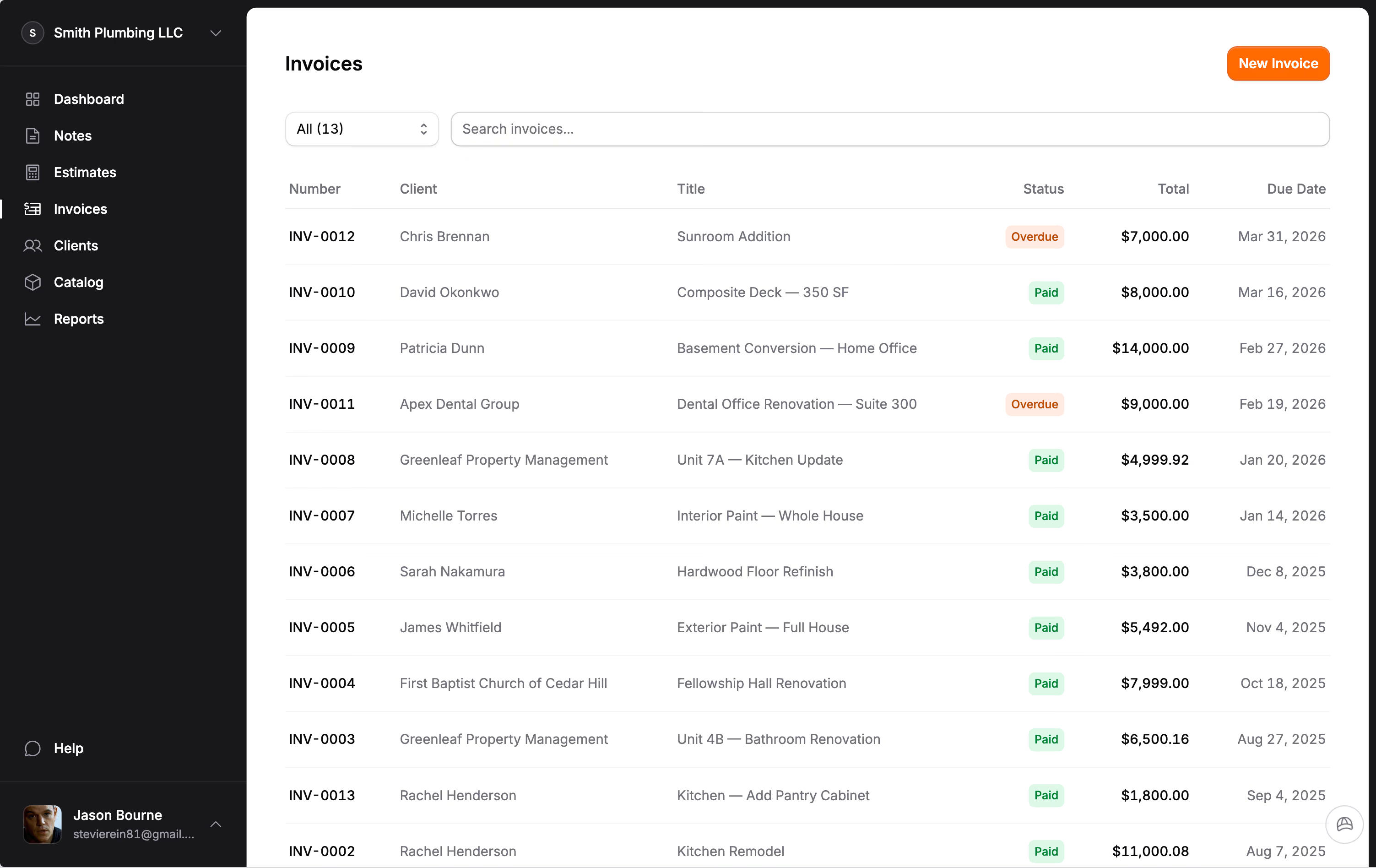
On-Site Invoicing vs. Office Billing: Which Actually Gets You Paid Faster
There is a moment on every job when your leverage is at its absolute peak. The client is standing in their freshly finished kitchen, or walking their new fence line, or flushing a toilet that actually works for the first time in a week. They are happy. The work is real and visible. Their wallet is mentally open. That moment is when your invoice should land. Not tomorrow. Not this weekend. Right now. The contractors who figure this out get paid in days. The ones who wait get paid in weeks, if they get paid at all.
The psychology of invoice timing
Client satisfaction does not stay constant after a job wraps. It peaks on completion day and drops steadily from there. On the day you finish, the client sees fresh paint, a working system, or a problem that no longer exists. By next week, that feeling has faded. The project blends into the background of their life. Your invoice becomes just another bill competing with their mortgage, their car payment, and their kid's soccer registration.
This is not speculation. A Fundbox study on small business cash flow found that invoices sent on the day work is completed get paid an average of 14 days faster than invoices sent a week later. We see this pattern across contractors we work with every week. The ones who invoice from the job site report average payment times under seven days. The ones who go home and "do invoicing on Sunday night" average three weeks or more.
That gap is not because their clients are different. It is because the timing is different. When the invoice arrives while the client is still thinking about the project, paying feels like closing the loop. When it arrives two weeks later, it feels like reopening a chapter they already moved past.
The "I will do it this weekend" trap
Every contractor has fallen into this one. You finish a job on Thursday afternoon. You are tired. You have another job starting Friday morning. You tell yourself you will sit down this weekend and get the invoice out. Then the weekend comes and you mow the lawn, take the kids somewhere, watch a game, and suddenly it is Monday. Another week starts. The invoice still has not gone out.
This is not a discipline problem. It is a friction problem. If invoicing requires you to sit at a desk, open a laptop, find the estimate, retype the line items, format everything, and figure out how to send it, of course you are going to put it off. The task feels like homework after a long day of physical work. So it gets pushed. And pushed again.
Meanwhile, the client has no idea an invoice is coming. They have not budgeted for it this week because you have not asked. By the time your invoice finally shows up, the mental connection to the completed project is gone. Now they are looking at a number on a screen with no emotional anchor to the work you did. That is a much harder ask than invoicing while the sawdust is still settling.
What same-day invoicing actually looks like
Invoicing from the job site sounds harder than it is. You do not need a desk or a laptop. You need a phone and a tool that lets you turn an estimate into an invoice in a few taps. If you wrote a detailed estimate before the job started, the line items are already there. The sections, quantities, prices, and terms are all documented. Converting that into an invoice should take less than two minutes.
Here is what that looks like in practice. You finish the job. You pull out your phone while the client is doing a final walkthrough. You open the estimate, convert it to an invoice, review the total, and hit send. The client gets the invoice by email with a payment link before you have loaded your tools back on the truck. Some clients will pay before you leave the driveway.
The key is having a mobile-first tool that keeps your estimates and invoices connected. If your estimate lives in one app and your invoices live in another, same-day invoicing requires retyping everything from scratch on a phone screen. Nobody is going to do that in a client's driveway. But if the estimate converts to an invoice in one step, carrying over all the line items and pricing automatically, the barrier drops to nearly zero.
What you need to invoice from the truck
The setup for on-site invoicing is simpler than most contractors think. You need three things: your phone, an estimating and invoicing app that works on mobile, and online payments turned on. That is it.
Your phone is the tool you already have in your pocket. The app needs to do two things well: let you create invoices from existing estimates without retyping, and let you send them with a payment link included. Online payments through credit card or ACH eliminate the "I will mail you a check" delay that adds another week or two to every transaction.
You do not need a portable printer. You do not need a card reader. You do not need to hand the client a paper invoice at the door. A clean invoice sent by email with a tap-to-pay link is faster and more professional than anything you could print in a truck. The client pays on their phone while you drive to the next job.
The data behind same-day invoicing
The numbers are not subtle. Contractors who invoice on the day the work is completed consistently report getting paid in under a week. Contractors who wait even a few days see that stretch to two weeks. Wait a week or more, and you are looking at three weeks on average, sometimes longer.
According to Intuit's 2025 Late Payments Report, 56 percent of US small businesses are owed money from unpaid invoices. A huge portion of that outstanding money is not from bad clients. It is from invoices that went out late, got lost in email, or sat in a queue because the contractor did not get around to it. Same-day invoicing eliminates that entire category of delay.
The payment link matters too. When the invoice includes an online payment option, the client can pay the moment they open the email. There is no check to write, no trip to the bank, no "I will get to it this weekend" on their end either. The easier you make it to pay, the faster the money moves.
When office billing still makes sense
On-site invoicing should be your default, but it is not the right call for every situation. Complex multi-phase projects with detailed reconciliation, retainage, or multiple change orders sometimes need a careful review before the final invoice goes out. If you are billing against a 12-page estimate with four approved change orders and a retainage clause, you want to sit down and make sure every number is right before you send it.
Commercial jobs with GC payment processes are another exception. When your invoice has to go through a pay application, approval chain, and net-60 terms, the speed of sending it from the site does not matter much. The bottleneck is on their end, not yours.
But for the vast majority of residential and small commercial work, same-day invoicing is the move. A fence install, a bathroom remodel, a furnace replacement, an electrical panel upgrade. These are jobs where the scope is clear, the estimate is documented, and the invoice should mirror the estimate almost exactly. There is no reason to wait. Jobkore makes this especially simple because your estimate converts to an invoice in one step, with all sections and line items intact, so you can review and send it in under two minutes from your phone.
Make on-site invoicing your default
The question is not whether on-site invoicing works. The data is clear and the logic is straightforward. The question is whether your current tools make it easy enough to actually do it. If invoicing requires a laptop, a quiet desk, and 30 minutes of formatting, you are going to put it off. That is human nature.
But if invoicing takes two minutes on your phone because the estimate is already built and the payment link is automatic, there is no reason to wait. Send the invoice before you leave the site. Let the client pay while the work is still fresh in their mind. That simple habit will change your cash flow more than any collection strategy, late fee policy, or follow-up system ever will.
Frequently Asked Questions
Should contractors invoice from the job site?
Yes, for most residential jobs. Client satisfaction and payment urgency are highest the moment work is complete. Invoicing on site while the client can see the finished work creates a natural prompt to pay. Contractors who invoice same-day consistently report getting paid within a week, compared to three or more weeks for those who invoice later.
What do you need to invoice from the truck?
A phone with your invoicing app, the client email address, and an online payment link. That is it. If your estimate is already in the system, converting it to an invoice takes seconds. Add any change orders, confirm the total, and send. The client gets a professional invoice with a pay button before you leave the driveway.
When does office billing make more sense than on-site invoicing?
For complex, multi-phase projects that require detailed reconciliation: commercial work with retention, projects with multiple change orders that need careful review, or jobs where the final scope requires back-office calculations. For straightforward residential work, on-site invoicing is faster and gets you paid sooner.
How much faster do contractors get paid with same-day invoicing?
Contractors we work with who invoice on the day of completion report average payment times of three to seven days. Those who wait until the following week or later report averages of 20 to 30 days. The difference is not the invoice itself but the timing. A same-day invoice arrives when the client is ready to pay.