Plumbing estimates and invoices, from the service call to the repipe.
Quote flat rate or hourly, bill the service call the day you do it, and stage the big jobs in draws. For plumbers and small crews.
Flat rate or hourly? Price each line the way you work.
Plumbing invoice software has to handle both ways plumbers charge, often on the same ticket. A water heater swap, a toilet set or a disposal is a flat price the homeowner can say yes to. Chasing a leak behind a wall is time and materials until you find it.
In Jobkore every line carries its own unit. A tank water heater install is one each, a PEX repair is by the linear foot, diagnostic time is by the hour. The service call fee is a line of its own, and if you credit it back when the customer books the repair, show the credit as a discount, so the math is on the page instead of in your head.
Load the Plumbing trade pack and your catalog starts with the work you do every week: faucet, toilet and disposal installs, tank and tankless water heaters, snaking and hydro-jetting, sewer camera inspections, leak repair, shut-off valves, pressure regulators, sump pumps, and service call and hourly lines. Set each price once and every estimate after that starts from your numbers.
The whole job, from your phone.
Estimates, invoices and payments for contractors who run their own business, in one app.
A water heater swap is more than a water heater.
The cheapest water heater quote in town is usually the one that stops at the tank. A closed system needs an expansion tank. The T&P discharge line has to run to an approved termination, not to the floor. The strap kit, the permit, and the haul-off of the old unit are real costs, and the plumber who leaves them off either eats them or argues about them later.
The same pattern runs through every job. Quarter-turn shut-offs at each fixture you touch. Dielectric unions where copper meets galvanized. A pressure test before the wall closes. And the drywall patch where you cut in, because the homeowner expects a finished wall, not a hole with new pipe in it.
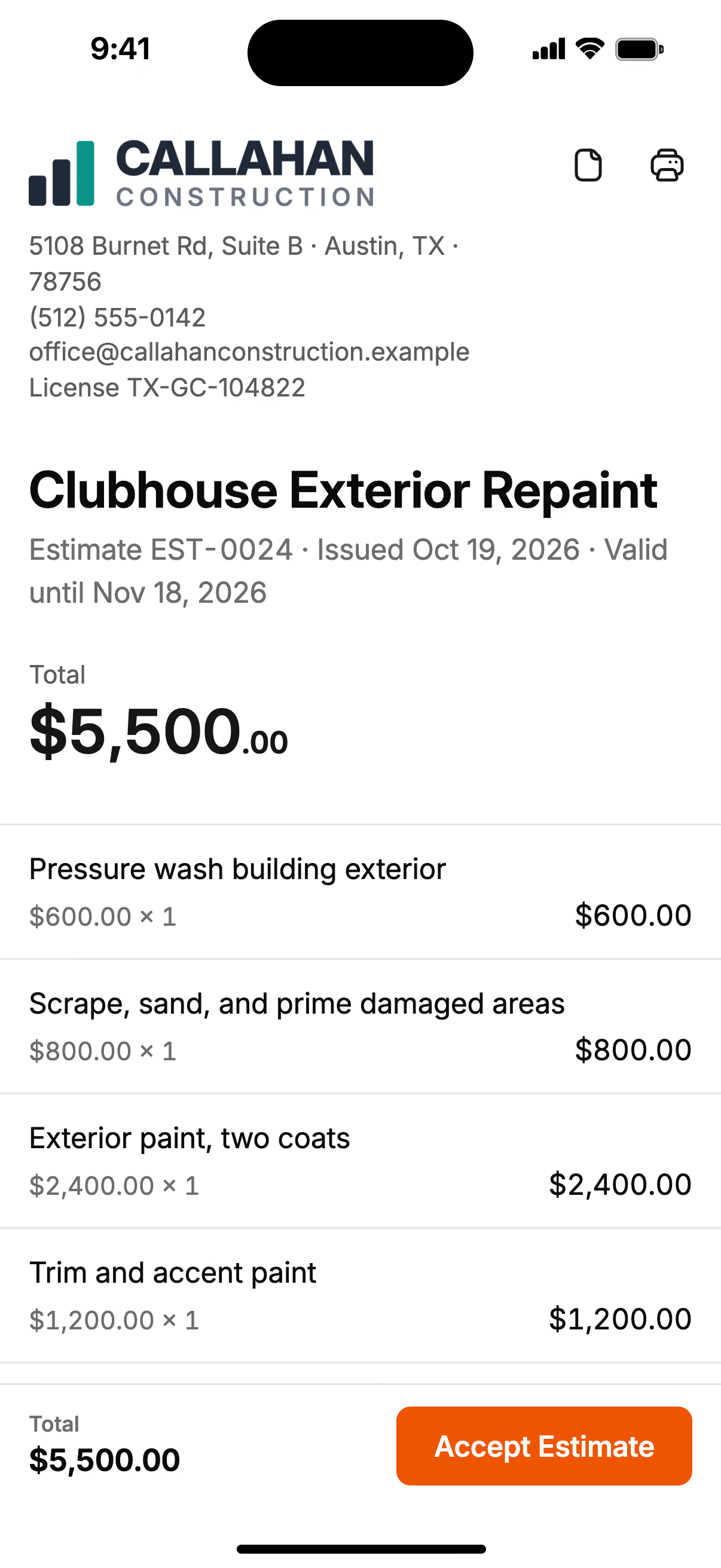
Put each of those on its own line and the homeowner can see what the higher number buys. It also answers the question every plumbing customer is really asking: am I about to be quoted a number I cannot check? An itemized quote is one they can check. More on building a plumbing estimate line by line.
The sewer line you have not seen yet goes on the bid as an allowance.
Some scope cannot be known until the camera goes in. A sewer line that looks like a spot repair can turn into a full replacement, and trenchless versus digging changes the price by thousands. Quote the camera inspection as its own line, and put the unknown repair on the estimate as an allowance: a budget the homeowner signs knowing it will be reconciled.
When the wall opens on galvanized where you expected PEX, or the homeowner decides the laundry is moving across the room, write a change order on the invoice. The client signs it online and the total updates. Nobody argues at the end about what was agreed, because it is written and signed.
Spell out rough-in versus trim, too. A homeowner who reads "rough-in" often assumes the faucets, toilets and trim kits are included. If they are not, the estimate is where to say so.
Bill the service call today, and the new construction job in draws.
Plumbing gets paid on two very different clocks. A service call should be paid the day it happens: send the invoice with a payment link and the customer pays by card or bank transfer before you are on to the next address. Stripe charges its standard rate and Jobkore adds nothing on top.
Bigger jobs pay in stages. Put them on one invoice with a payment schedule: a deposit for the fixtures or the water heater, a draw after the rough-in or top-out inspection, and the balance after trim and the final test. Each row has its own due date, payments fill the rows in order, and the last row is always the balance, so the numbers always add up.
If a payment runs late, Jobkore sends reminders at 1, 7 and 14 days, then stops. Invoices and payments sync one way to QuickBooks Online for your bookkeeper.
And the rest of the job, built in.
- Change orders. Signed on the link your client already has.
- Deposits and draws. On one invoice, with late reminders.
- QuickBooks sync. Invoices, payments and clients, without retyping.
- English or Spanish. The app, your documents and Hank.
Hank drafts the job the way a plumber writes it.
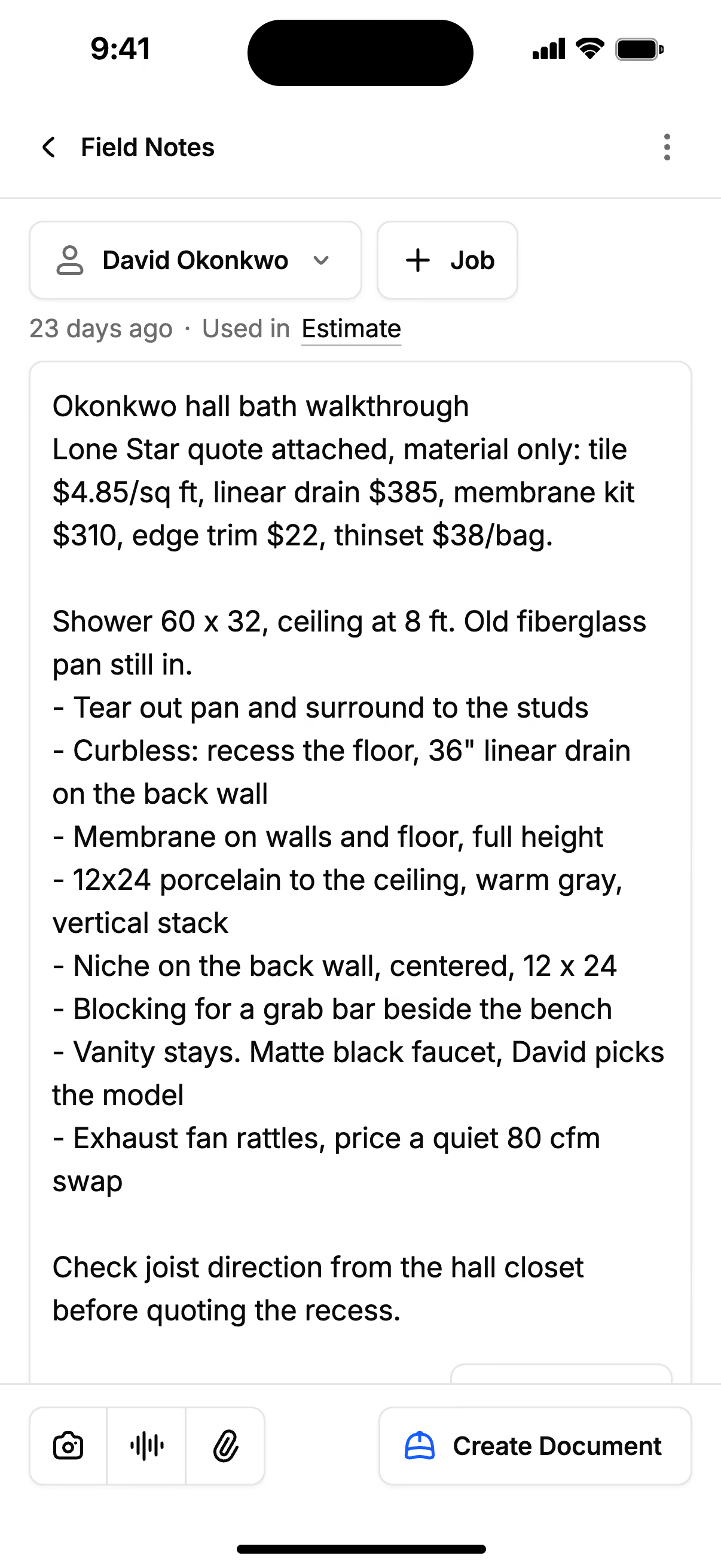
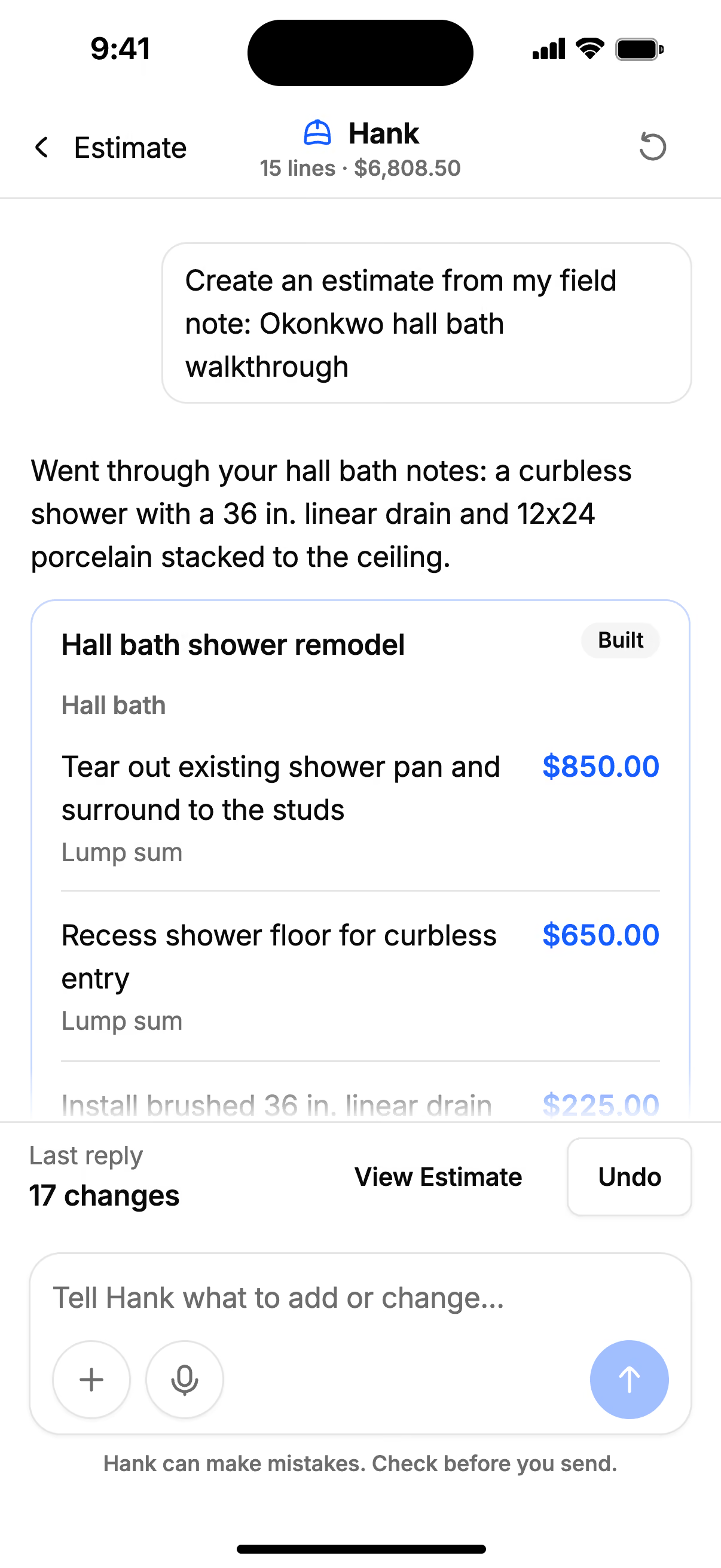
Jobkore includes Hank AI™, an assistant that knows the trade you picked at signup. Tell him the job by typing or with a voice memo: 50-gallon gas water heater, 12 years old, no expansion tank, T&P line runs to the floor, garage install. He drafts the estimate with the lines a water heater job needs, quantities filled in and priced from your catalog first.
He knows the usual waste on pipe (about 10 percent on PEX and PVC, 8 on copper) and the traps plumbers lose money on: the missing expansion tank, backflow where the jurisdiction requires it, the drywall patch nobody priced. Change anything, or ask him to.
Turn on a review before sending and Hank checks the estimate against the same plumbing list. He can add a missing line or an allowance, and he never changes your prices in a review. You read it and send it.
What Jobkore does for a plumber.
Jobkore is for bidding and billing: estimates, change orders, invoices and payments, for one plumber or a small crew.
It runs on your phone, and the whole app works in Spanish as well as English, Hank included. The price is on the pricing page: one plan, no per-user price.
Plumbers who also do heating work can see the HVAC page. Bathroom and kitchen jobs overlap with remodeling, and burst pipes and water damage with restoration.
Common questions.