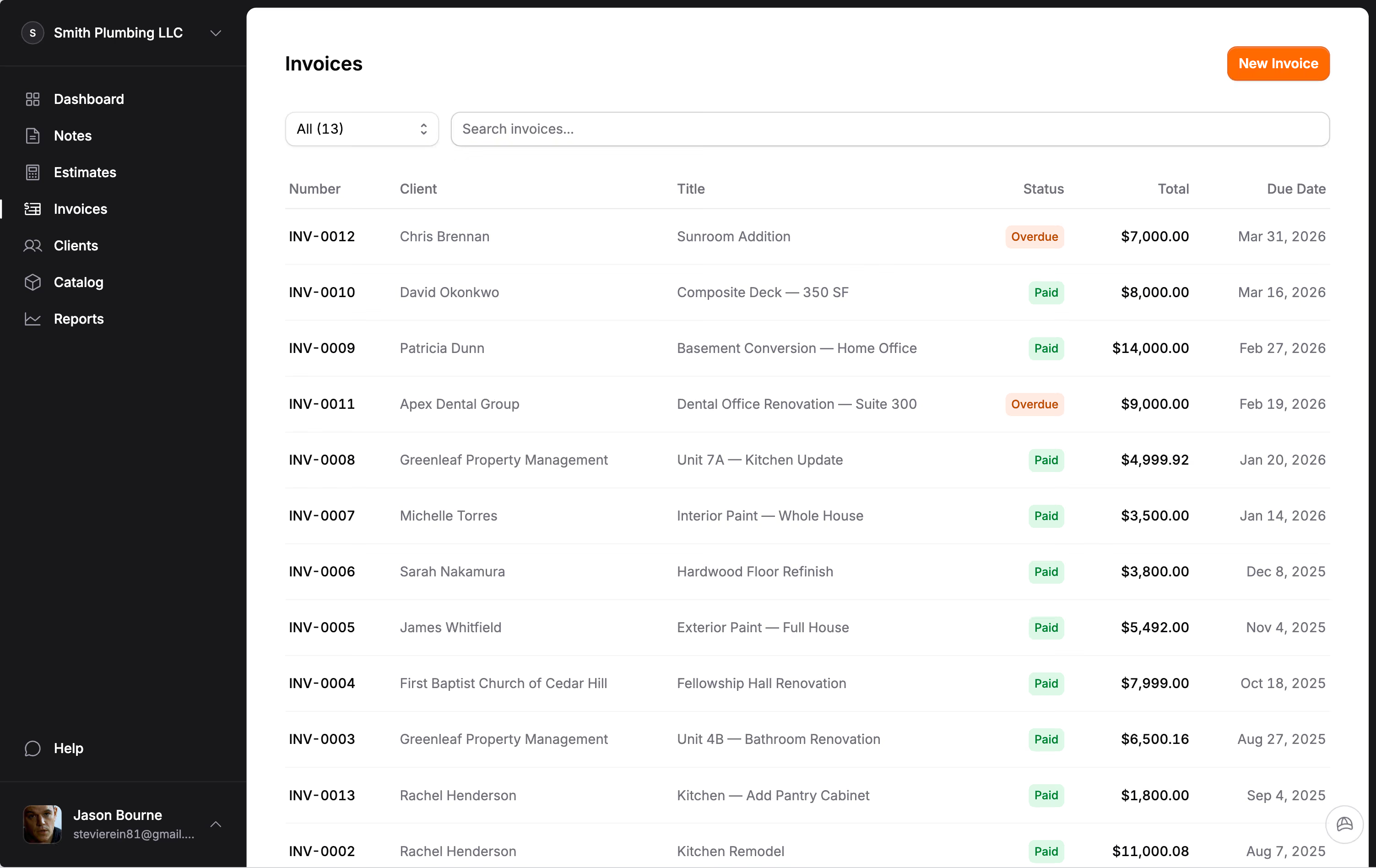
Siding and gutter estimates and invoices, with the trim priced in.
Price the siding by the square foot, the trim and gutters by the linear foot, and the rot you will find behind it as an allowance. For small siding and gutter crews.
Siding by the square foot, accessories as their own lines.
Siding estimating software has to price what a square-foot number hides. Corner trim, J-channel, starter strip, soffit and fascia can be 15 to 25 percent of the real cost of a siding job. Bundle them into the square-foot rate and the bid looks cheap until you are the one paying for them.
In Jobkore every line carries its own unit. Vinyl or fiber cement by the square foot, soffit, fascia and trim by the linear foot, gutter guards by the linear foot, downspouts each. Count the waste in the quantity: about 10 percent on vinyl and fiber cement, closer to 12 on cedar, and around 5 on gutter stock.
The Siding & Gutters trade pack starts your catalog with vinyl and fiber cement siding by the square foot, siding repairs, soffit and fascia by the linear foot, 5- and 6-inch gutters, gutter cleaning and repairs, screen and micro-mesh gutter guards, and downspout installs. Set each price once, and every estimate starts from your numbers.
Price what goes behind the siding.
The homeowner's real question is whether water is getting behind the old siding, and whether the new siding will stop it. The answer is mostly in the layers they will never see, so put those layers on the estimate. Tear-off and haul-off with a dumpster sized to the job. House wrap integrated with flashing at every penetration. Flashing at windows, doors, roof-wall intersections and deck ledgers. A rain screen or furring behind cedar or fiber cement where the manufacturer calls for it.
Once the old siding is off, you will find soft sheathing or failed weather barrier somewhere. Carry an allowance for it on the estimate, a budget the homeowner signs knowing it will be reconciled. When the tear-off finds more than the allowance covers, the difference goes on the invoice as a change order the homeowner signs online.
Finish with paint touch-up or color-matched caulk at trim ends and penetrations, as its own line.
Gutters: size them, hang them, and give the water somewhere to go.
A gutter bid is more than linear feet. Five-inch K-style is standard, but a steep roof with long runs needs six-inch, and undersizing is how you get overflow and rotted fascia. Hidden hangers with screws at 18 to 24 inches outlast spikes and ferrules. Write the size and the hanger on the estimate so the homeowner is comparing like with like.
Then the downspouts: how many, and where the water ends up. Extensions, splash blocks or a tie into an underground drain each belong on the estimate, because a downspout that dumps at the foundation is the wet basement call you get next spring.
Price gutter guards as their own optional line rather than folding them in, so the homeowner can say yes or no. More on why itemized estimates win over lump sums.
Old siding on a pre-1978 house.
A lot of aluminum and vinyl siding was nailed over painted wood, and on a house built before 1978 that paint may contain lead. The EPA says the renovation rule applies to exterior work that disturbs more than 20 square feet of painted surface, which a siding tear-off can easily pass.
When it applies, it means a certified firm, containment and lead-safe cleanup. That costs time and material. Put testing and containment on the estimate as their own lines, so the homeowner understands the number and you are not covering compliance out of your margin.
Photos help make the case: up to 20 on the document and 6 on a single line. A photo of the painted clapboard under the old aluminum siding beside the containment line explains it.
Deposit, materials, completion, and storm jobs.
Siding jobs usually pay in three parts: a deposit at signing, a payment when materials are delivered, and the balance at completion. Put them on one invoice with a payment schedule, each row named and dated in the order the money comes in. Payments fill the rows in order and the last row is always the balance.
The homeowner pays by card or bank transfer from the invoice link, or you record an insurance check when it arrives. Stripe charges its standard rate and Jobkore adds nothing. Late payments get reminders at 1, 7 and 14 days.
For hail and wind claims, tell Hank the job is an "insurance claim" and he lays the estimate out the way adjusters read one: every line itemized, waste on its own line, overhead and profit kept separate. Whether a carrier accepts it is up to the carrier.
Hank knows what a siding bid leaves out.
Jobkore includes Hank AI™, an assistant that knows the trade you picked at signup. Tell him the job by typing or with a voice memo: two-story colonial, 2,400 square feet of old aluminum over clapboard, going to fiber cement, new soffit and fascia, 180 feet of six-inch gutter, eight downspouts. He drafts the estimate by category, priced from your catalog first, with the usual waste.
Turn on a review before sending and he checks it against a siding list: accessories left out of the square-foot price, no sheathing allowance, undersized gutters, downspouts with nowhere to go. He can add the missing line or an allowance and never changes your prices in a review.
Jobkore does the estimate, the change orders, the invoice and the payments, in English or Spanish. Related trades: roofing, windows and doors and painting. See the pricing page.
Common questions.