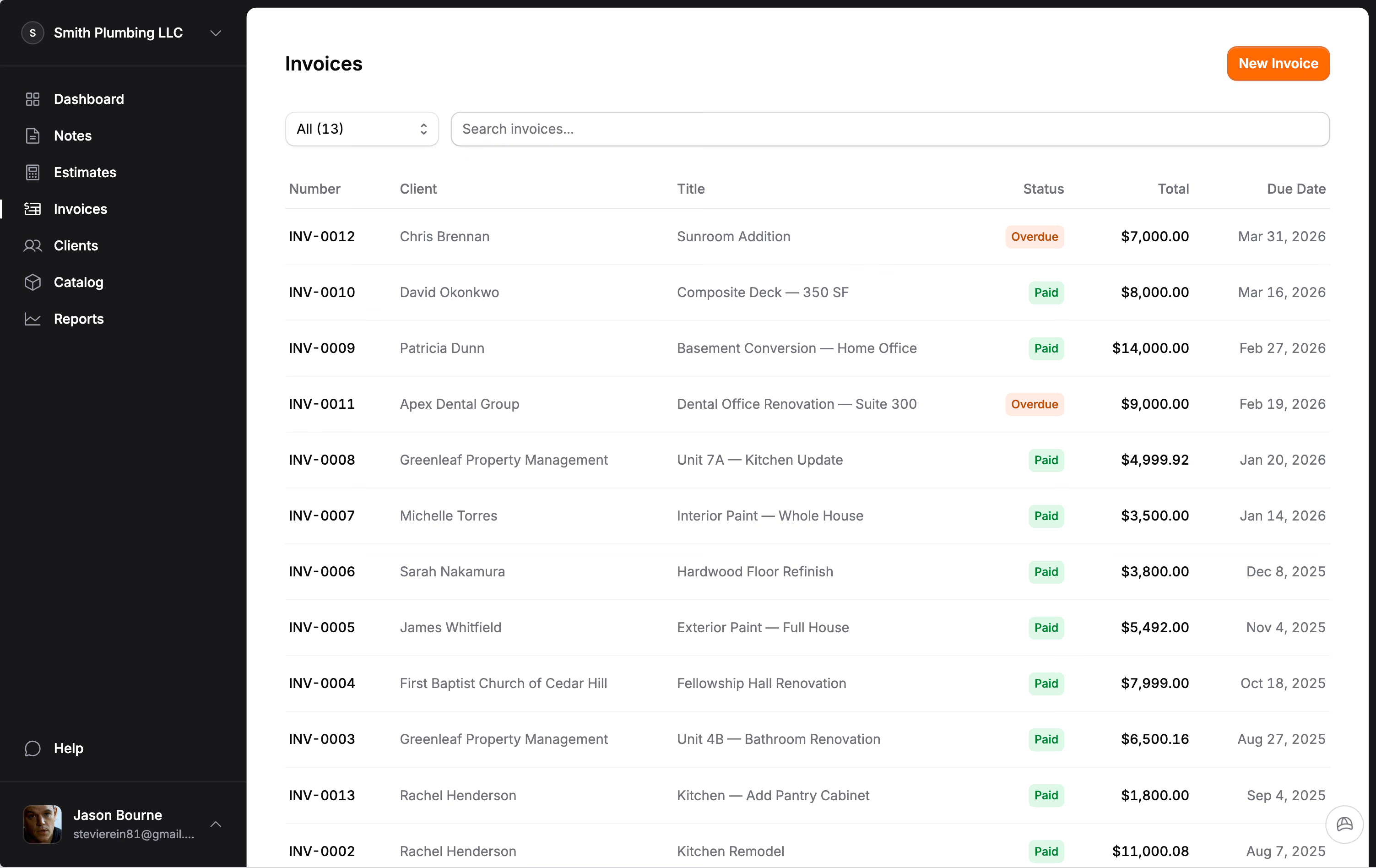
Moving and hauling estimates and invoices, with no surprise at the end.
Quote the crew, the truck, the hours and every surcharge up front, put the valuation choice in writing, and get paid when the last box comes off. For small moving and hauling crews.
Hourly or flat, and exactly what it covers.
Moving and junk removal software has to answer the customer's real question before the truck shows up: will the final bill match the quote? Start with the scope and the pricing method. A local move is usually hourly, with a minimum. A junk haul with a known pile can be a flat price by the load. A single heavy item, a piano, a safe or a hot tub, is its own price.
Say the crew and the truck: two movers and a 16-foot truck, or three and a 26-foot. Say what the hourly clock includes, such as drive time, and what makes a bill go over, such as a longer day than estimated, stairs or a long carry.
In Jobkore every line has its own unit: labor by the hour, junk by the load, appliances and specialty items each. Load the Moving & Hauling trade pack and your catalog starts with local move labor, loading and unloading, packing and furniture assembly by the hour, truck and heavy-item fees, packing materials, junk removal by the load, appliance haul-away and storage cleanouts. Set each price once, and every estimate starts from your numbers.
Surcharges belong on the estimate, not the final bill.
The fastest way to lose a customer's trust is a surcharge they first see on the final bill. Put them on the estimate instead, even as "if applicable." Stairs, per flight. A long carry from the door to the truck. An elevator that has to be reserved. A piano, a safe or a pool table that needs special equipment.
Say whether protection supplies are included: moving pads, shrink wrap, floor runners and door jamb protectors. If boxes and packing are extra, price them. Say what the crew will not move, such as hazardous materials, so it is not a surprise on moving day.
Photos help at both ends: up to 20 on the document and 6 on a single line. A photo of the third-floor walk-up and the narrow stairwell on the estimate explains the stair charge before anyone argues about it.
Valuation and authority, in writing.
When something breaks, what the customer gets back depends on the valuation they chose, and without a signed choice the dispute is yours. Explain the options on the estimate, the basic released-value coverage that pays far less than an item is worth versus a higher level of protection, and have the customer pick one when they sign.
If you move household goods across state lines, you need federal registration with the Federal Motor Carrier Safety Administration, and some states license in-state movers too. Put your registration or license number in Jobkore once and it prints on every estimate and invoice.
Commercial customers and property managers will ask for a certificate of insurance. Have it ready, and note your coverage in the estimate so it is not a question on moving day.
See the pile before you price the haul.
A junk haul quoted by the load without seeing the pile is a guess. Concrete, dirt, roofing and wet materials hit a truck's weight limit long before they fill it, so a "full load" can be half a load of heavy debris. Look first, or ask for photos, and price by the load with the weight in mind.
Disposal is real money. Put dump fees on the estimate as their own line or build them into the load price, and keep the disposal tickets. Appliances with refrigerant and electronics often have to go to specific recycling sites, and that trip is a line too.
When the customer adds the garage on the day, write a change order on the invoice with the extra load. They sign it online and the invoice total moves to include it. More on what customers read on an estimate.
A deposit to hold the date, paid at delivery.
Moves are often booked weeks ahead, so a deposit to hold the date is common, with the balance at delivery. Put both on one invoice with a payment schedule, each row named and dated. Payments fill the rows in order and the last row is always the balance.
For an hourly move, the invoice shows the actual hours, so the customer sees the estimate and the final side by side. They pay by card or bank transfer from the invoice link on their phone before the crew leaves. Stripe charges its standard rate and Jobkore adds nothing on top.
Late payments get reminders at 1, 7 and 14 days, and invoices and payments sync one way to QuickBooks Online.
Hank knows the moving and hauling traps.
Jobkore includes Hank AI™, an assistant that knows the trade you picked at signup. Tell him the job by typing or with a voice memo: two-bedroom apartment, third floor walk-up to a house across town, upright piano, three movers and a 26-foot truck, customer packing themselves. He drafts the estimate with the hours, crew, truck, stair and piano charges, priced from your catalog first.
Turn on a review before sending and he checks it against a moving list: no stair or long-carry charge on a walk-up, a specialty item priced like furniture, no valuation choice, a junk haul priced by the load on heavy debris. He can add the missing line and never changes your prices in a review.
Jobkore does estimates, change orders, invoices and payments, on your phone, in English or Spanish. Related trades: cleaning, home staging and demolition. See the pricing page.
Common questions.