Construction Escalation Clause: Bidding When Prices Move
An escalation clause is a short paragraph on your estimate that says who pays if a named material gets more expensive between the day the client signs and the day you buy it. Most residential contractors skip it because it sounds like something written for a hospital job. On a remodel that signs in September and starts in November, it decides whether a price jump becomes a small change order or comes out of your pay.
Why a 30-day estimate stops protecting you once the client signs
A validity date protects you only until the client says yes. After that the price is fixed and the material bill is not. On a kitchen that signs in September and starts in November, you are buying copper, wire, lumber and cabinets at November prices on a number you wrote in September.
Those prices have not been standing still. Residential building materials were up 5.1 percent over the twelve months to August 2026, and softwood lumber was up 13 percent, according to the National Association of Home Builders. The metals moved faster: the Associated General Contractors of America reported steel mill products up 23.4 percent, aluminum up 27.3 percent and copper and brass up 20.9 percent over the same year.
Wire, pipe, fittings, flashing and fasteners are all made from those metals. You do not need a commercial job to feel it.
What an escalation clause for a remodel actually says
A usable residential escalation clause has five parts, and none of them needs a lawyer to understand. Name the materials it covers, and only those. Record the price the estimate is based on, with the supplier and the date.
Set a threshold the price has to pass before anything changes; 5 to 10 percent is common. Require proof: the supplier's quote at signing and the invoice at purchase. And give the client a way out if the increase gets large.
That last part is the one commercial contracts tend to leave out, and it is the one homeowners care about most. The sample clause the National Association of Home Builders publishes for its members lets the owner cancel if the increase passes a percentage the owner picks, paying for work done to date. It turns "the contractor can raise my price" into "I have a ceiling and an exit."
Price adjustment for named materials. The price above is based on supplier quotes dated [date] for: copper pipe and fittings, $[amount]; electrical wire, $[amount]. If our cost for any of these rises more than 5 percent above that quote before we buy it, we will send you the supplier's current invoice and a written change order for the amount above 5 percent. If our cost falls more than 5 percent, we will credit you the same way. If the total increase would exceed [X] percent of the contract price, you may cancel and pay only for work completed and materials already purchased.
Treat that as a starting point, not a legal document. Your state gets a say in how it is used, which we come back to below.
A worked example: where the money goes
Picture a remodeler who bids a $42,000 kitchen in September. The supplier quotes the copper supply lines and wire package at $4,000, the homeowners sign at their kitchen table, and demo is set for November.
When the order goes in, the same package is $4,600, a 15 percent jump. Without a clause, the remodeler calls the homeowners, asks for $600, hears "but we signed," and eats it. It is rarely one package, either: the lumber and fixtures priced that same September day can move with it.
With the clause above, the first 5 percent, $200, is the remodeler's to absorb, which is fair on a fixed-price job. The other $400 goes on a change order with the supplier invoice attached, and the homeowners see a $400 line with proof instead of an awkward phone call.
Make it work both ways, even though it sometimes costs you
Our position, which not every contractor will like: if you write an escalation clause, put the de-escalation in the same paragraph. If copper drops 8 percent between signing and purchase, the client gets the credit. Most contractors would rather have the protection without the give-back, and we understand why.
But a one-way clause reads to a homeowner as "heads I win, tails you lose," and they are right to read it that way. A two-way clause is easier to present at the kitchen table and easier to defend if the client ever disputes it. It also keeps you honest about naming only the materials that actually swing.
Metals and lumber have spent the past year moving in one direction, so the credit side has cost very little. What it buys is a signature from the client who would otherwise have chosen the contractor whose number looked fixed.
Your state decides how the price change is documented
An escalation clause does not let you change the price by text message. In most states the clause itself is allowed, but home improvement laws control how any price change is written up, and they protect homeowners more than commercial clients. California's Contractors State License Board says any change to the price or scope of a home improvement contract must be a written change order signed by both the customer and the contractor before the change.
New York's home improvement law likewise requires changes to the contract to be in writing and signed by both parties. So the clause is the agreement to adjust the price, and the signed change order is how you actually do it, every time it triggers. Skip the second step and a perfectly good clause may not help you collect on it.
If you do not already have a written change order process, build that first. This is not legal advice, and rules vary by state, so keep your licensing board's contract requirements in front of you when you write yours.
How to bring it up without losing the job
Present the clause out loud, before the client finds it in the fine print. Point at the named materials and say what they are: "These are the items that have moved the most this year. If they go up more than 5 percent before I buy them, you will see the invoice and a change order. If they go down, you get the credit." Homeowners who have been reading about tariffs usually take that well.
The alternative is padding the price to cover a jump that may never come, and it is worse for everyone. You either lose the bid to a lower number, or you charge the client for risk they never saw. An escalation clause on three named materials costs the client nothing unless prices actually move. It also shows the client you priced the job honestly instead of hiding a cushion in it.
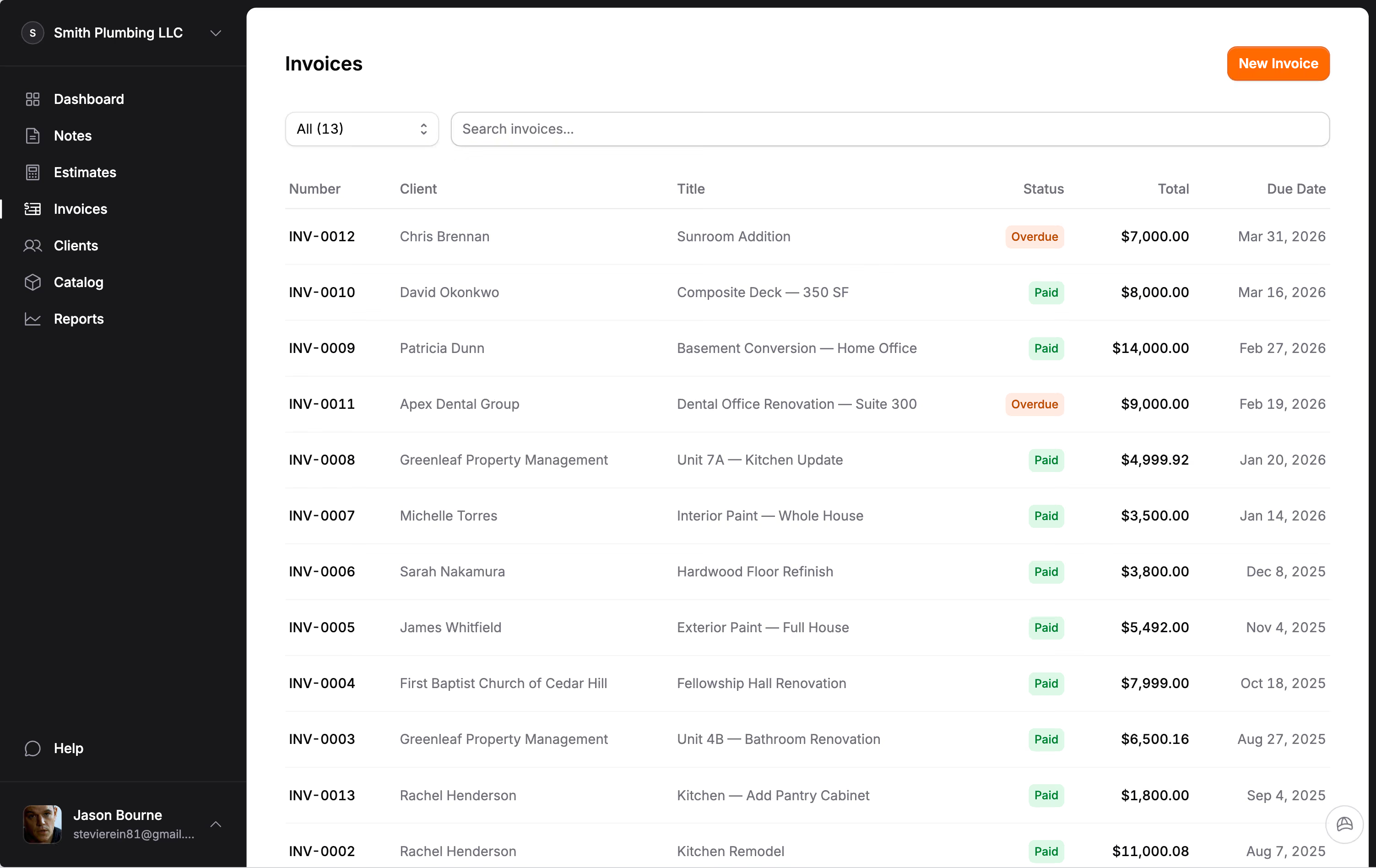
Keep the clause in your standard estimate terms and conditions so it goes out on every job without retyping. In Jobkore that means Default Terms & Conditions under Settings, in Document Defaults, next to the Valid For setting that controls how long an unsigned estimate holds its price. When the clause triggers, the increase goes through as a change order the client approves before you buy.
Price-check three materials this week
Pull the signed estimates for jobs that have not started yet. For each one, pick the two or three materials that make up the biggest share of the material cost, and ask your supplier for today's price. Compare it with what you bid. If any are up more than 5 percent, you now know what an escalation clause would have been worth, and which materials to name on the next estimate you send. Write the clause once, put it in your default terms, and stop guessing.
Copper is going to do whatever copper does between now and November; the part you control is what your estimate says about it.
Frequently Asked Questions
What is an escalation clause in a construction contract?
An escalation clause lets the contract price change if named materials cost more than an agreed baseline by the time they are bought. A good residential one names the materials, records the quoted price and date, sets a threshold such as 5 percent, requires invoices as proof, and gives the homeowner a way out.
Are escalation clauses legal in residential construction?
Generally yes, but state home improvement laws control how a price change is documented. California requires a written change order signed by the homeowner and contractor before the change, and New York requires contract changes in writing signed by both parties. Check your licensing board before relying on one.
What percentage should trigger an escalation clause?
Most clauses set a threshold of 5 to 10 percent above the quoted price. Below it, the contractor absorbs the increase as part of taking a fixed-price job. Above it, only the amount over the threshold passes to the client, backed by the supplier invoice and a signed change order.
Can a contractor raise the price after the contract is signed?
Only if the contract allows it and the change is documented the way your state requires. Without an escalation clause, a signed fixed price usually stands and the contractor absorbs material increases. With one, the increase goes through as a written change order the client signs before the material is bought.