Contractor Hourly Rate: The Math Most Contractors Skip
A carpenter on someone else's payroll earned a median of $29.12 an hour in May 2025. A self-employed carpenter who charges $50 an hour is very likely paying themselves less than that, once the truck, the taxes and the hours nobody pays for come out. The right hourly rate is not what the guy down the road charges. It is a number you build from your own costs, and most contractors have never done the math.
The employee wage is your floor, not your rate
Start with what the same work pays on a payroll, because that is the least you should earn for doing it on your own. The Bureau of Labor Statistics puts the median carpenter wage at $60,580 a year, or $29.12 an hour, as of May 2025. Electricians came in at $30.38 and plumbers at $30.67. Those employees drive a company truck, work under someone else's insurance, and get paid for every hour they are on the clock, including the hour spent waiting on a supply house counter.
You get none of that. Every one of those costs moves onto your side of the ledger, and the only place it can come back from is the rate you charge. A self-employed rate that merely matches the payroll wage is a pay cut with extra paperwork.
So the question is not "what is a fair hourly rate for a contractor?" It is "what do I have to charge to come out ahead of the job I could take instead?"
Build the rate from the bottom up
The honest way to set a rate is to add up a year of costs and divide by the hours a client will actually pay for. Here is the math for a solo carpenter who wants to clear roughly what an electrician earns on payroll. Every figure except the tax rate and mileage rate is an example; put your own numbers in its place. The order matters less than the rule behind it: anything the business pays for, whether or not a client ever sees it on an invoice, has to be recovered in the hours a client does pay for. Leave a cost off this list and you have not saved it. You have agreed to pay it out of your own wage, one job at a time, without deciding to.
- Your pay: $62,000. The wage you would accept to do this work for someone else.
- The employer's half of payroll tax: about $4,700. The self-employment tax rate is 15.3 percent. An employee pays half of that; you pay both halves.
- Health coverage and retirement: $9,000. What a benefits package would have given you.
- The truck: $11,400. 15,000 business miles at the IRS standard rate of 76 cents a mile, which took effect July 1, 2026.
- Insurance, license, phone, software and tools: $6,000.
That totals about $93,100 a year before a single dollar of profit.
You do not get paid for 2,080 hours
The number most contractors skip is the divisor, and it is the one that moves the rate the most. A full-time year is 2,080 hours on paper. Take two weeks off and you are at 2,000. Then take out the hours that are real work but nobody's invoice: driving between jobs, quoting jobs you do not win, supply runs, callbacks, chasing payments, and the evening you spend on paperwork. We have not found a government or trade-association figure for what share of a small contractor's week is billable, so be wary of anyone who quotes you a precise one. Track your own for two weeks. If 65 percent of your working hours end up on an invoice, you have about 1,300 billable hours a year, not 2,080.
Divide $93,100 by 1,300 and your break-even rate is about $72 an hour. Divide it by 2,080, the way most people do in their heads, and you get $45, which is how a contractor charging $50 works full weeks and still wonders where the money went.
Profit is a separate line from your pay
Break-even is not the rate, because break-even means the business itself earns nothing. The $62,000 in the math above is what you would earn as an employee. Profit is what the business earns on top of that, for carrying the risk an employee never carries: the job that runs long, the client who does not pay, the slow month in January. Add even 10 percent and the rate lands near $79 an hour. That money is what buys the next truck without a loan, and what gets you through a bad quarter without cutting your own pay.
How you apply that percentage matters, because a markup and a margin are not the same number. We covered the difference in markup versus margin, so we will not repeat it here.
The point for now is that profit belongs in the rate on purpose, not in whatever happens to be left over.
Charge your number, even when it is higher than the market
Here is where we part ways with most pricing advice: do not lower your rate to match the market if your math says otherwise. If the contractors around you charge $55 and your costs say $79, either their costs are lower than yours, or they are underpricing and funding it out of their own pay. Matching them puts you in the second group. A low rate is also hard to walk back, because the clients it attracted are the ones most likely to leave when it goes up. When clients balk, change what you sell rather than what you charge: bid by the job instead of the hour, work where your speed is an advantage, or drop the small jobs that eat your unbillable time. We walked through that tradeoff in hourly versus flat-rate pricing, and the math above is what makes a flat price safe to quote.
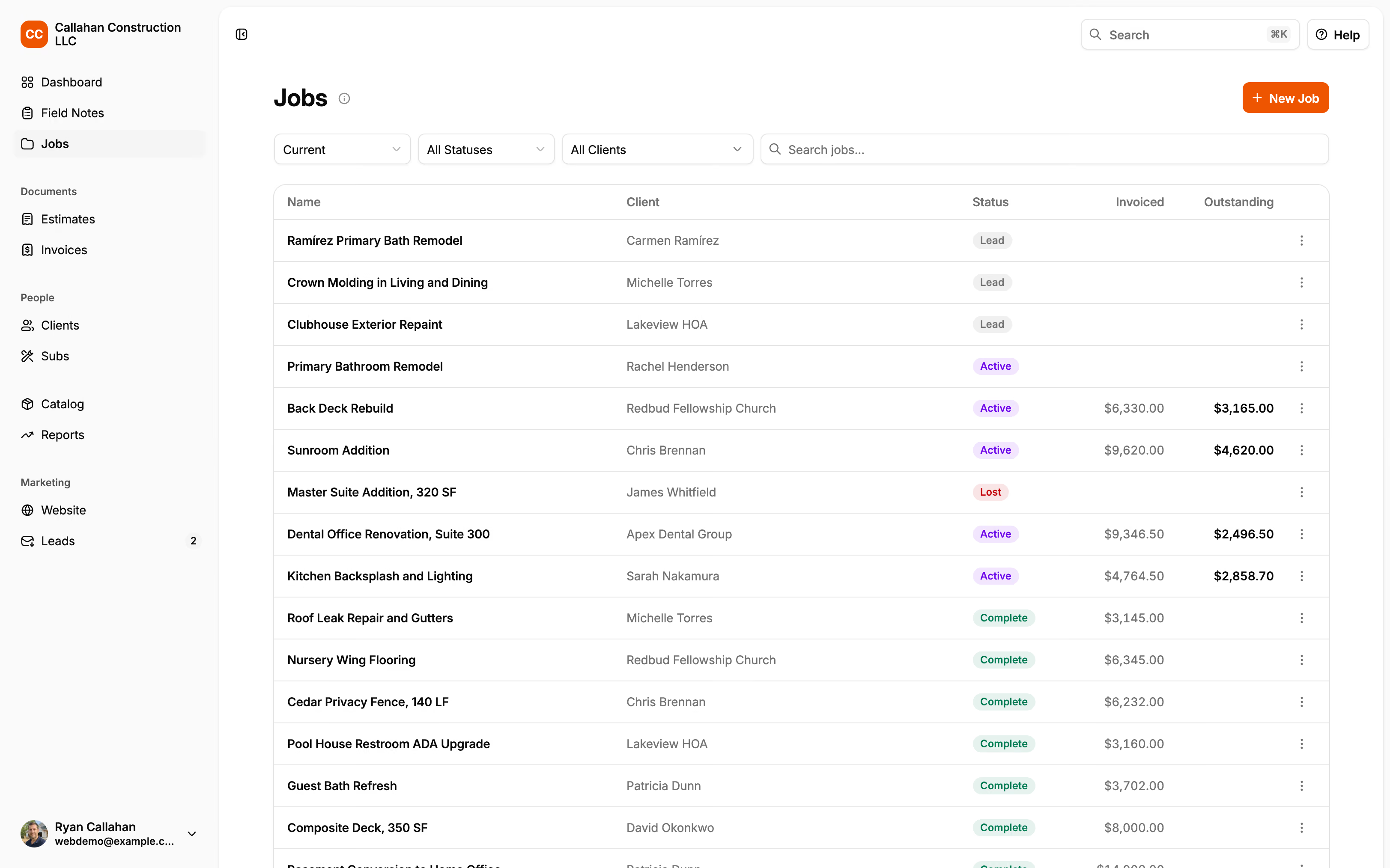
Once you have the number, put it where it gets used every time. In Jobkore it goes in Default Rate under Settings, in Rates & Terms, which pre-fills the rate on every new line item, so your estimates start from your math instead of a figure typed from memory.
Run your real numbers this week
Pull last year's bank statements and total the truck, insurance, phone, software and tools. Then track your hours for the next two weeks in two columns: hours worked and hours that ended up on an invoice. Put both into the math above. It takes one evening, and it will either confirm your rate or tell you exactly how much you have been giving away on every job.
If the answer is higher than what you charge today, the gap is coming out of your own pay on every job. Better to learn that from a spreadsheet than from a slow winter.
Frequently Asked Questions
How do I calculate my hourly rate as a contractor?
Add up a year of costs: the pay you want, the extra self-employment tax, benefits, your truck, insurance, tools and software. Divide by the hours a client actually pays for, not the hours you work. Then add a profit percentage on top, separate from your own pay.
How many billable hours does a contractor have in a year?
Far fewer than 2,080. Time off, driving, quoting, supply runs, callbacks and paperwork all come out. There is no authoritative industry figure, so track your own hours for two weeks. At 65 percent billable, a 2,000-hour working year yields about 1,300 billable hours.
Should a contractor charge more than an employee earns per hour?
Yes, usually much more. An employee is paid for every hour on the clock and does not pay for the truck, insurance or the employer half of payroll tax. A self-employed rate that only matches a payroll wage is a pay cut once those costs come out.
What if my calculated rate is higher than other contractors charge?
Do not cut it to match. Either their costs are lower, or they are underpricing and paying for it themselves. Change what you sell instead: bid by the job, focus on work where you are fast, or drop small jobs that eat unbillable time.