Contractor Year-End Checklist: What to Close Out for 2026
Say a remodeler finishes 2026 with $41,000 in open invoices, three subs paid without a W-9 on file, and a plan to buy a new truck in December to "save on taxes." Each of those turns into a problem in January, when it is harder and slower to fix. The year-end checklist below is the short version of what to close out before December 31 and what lands in the first weeks of 2027.
None of it is complicated. It is just easy to put off while the last jobs of the year are still running.
This is general information, not tax advice. Your accountant knows your numbers, and a half hour with them in November costs less than one in April.
Collect what you are owed before the year closes
Start with money, not taxes. An invoice that has been open since September is worth less every week it sits, because the client who has not paid in 60 days is far more likely to stall again than the one who paid in 10. December is a good month to ask: clients are closing out their own year, and plenty of them would rather settle the bill than carry it into January.
Pull every open invoice and sort it by age. Anything past 30 days gets a phone call, not another email. Anything past 90 days gets a written notice with a date, and the steps in our guide on what to do when a client won't pay. Partial payments count too: a $12,000 job that collected an $8,000 deposit still has a $4,000 balance that nobody is chasing.
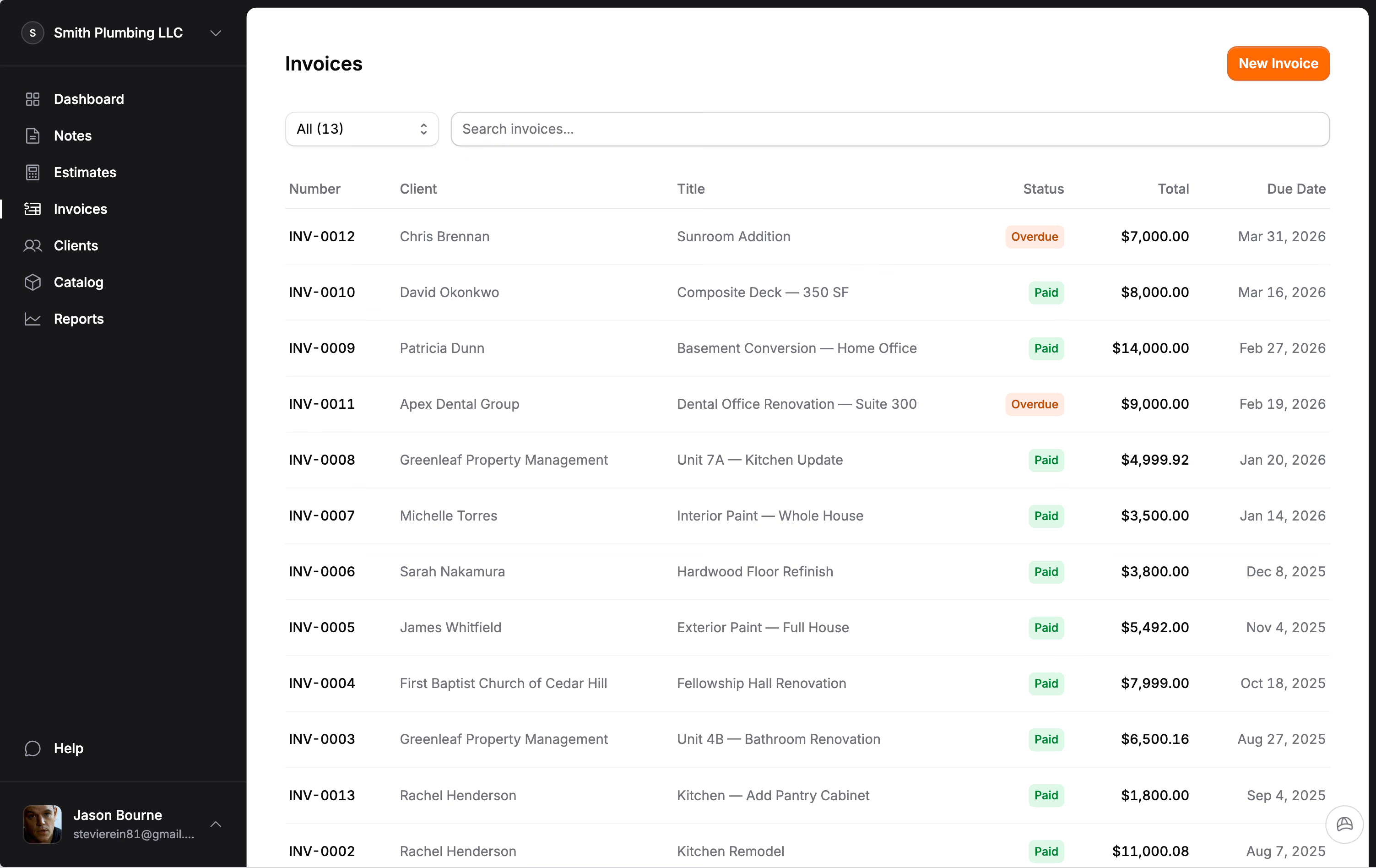
If you send invoices with a pay link, this is where it earns its keep. A client who can pay by card or bank transfer from the invoice settles it in the same minute they decide to, instead of waiting until they find the checkbook.
Get a W-9 from every sub now, not in January
If you paid an independent subcontractor for work in 2026, you may owe them a Form 1099-NEC, and the IRS. For payments made in 2026, the reporting threshold is $2,000, up from the $600 that applied for years. That higher number means fewer forms for small jobs, but it does not change the paperwork for the subs you use every month: total what you paid each one, and file for anyone over the line. More on what the new 1099 threshold changes.
You cannot file without the sub's legal name and taxpayer ID, which come from their Form W-9. Asking for it in December, while you still owe them a check, takes one text. Asking in late January, when they have been paid and moved on to the next job, can take three weeks you do not have. The forms are due to the sub and the IRS by January 31, which in 2027 falls on a Sunday, so the deadline is Monday, February 1.
While you are collecting W-9s, check each sub's certificate of insurance. A sub whose coverage lapsed in October and kept working on your jobs is a problem your own insurer will ask about at your next audit. Jobkore keeps each sub's insurance expiry date and flags it as it gets close, and Reports exports Subcontractor Payment Totals for any date range, which is the list your accountant needs for 1099s.
The dates that land in January
Year-end work is mostly about what comes due right after it. Write these on the calendar now, because they arrive while you are bidding spring work and they do not move. Dates as of November 2026:
- January 15, 2027: the fourth-quarter estimated tax payment for 2026, if you pay estimated taxes as a self-employed contractor.
- February 1, 2027: Forms 1099-NEC to each sub you paid $2,000 or more, and to the IRS.
- February 1, 2027: W-2s to employees and the W-3 to the Social Security Administration, if you had payroll (January 31 is a Sunday, so these move too).
- Your renewal dates: general liability, workers' comp, vehicle insurance and your contractor license. Many renew on the calendar year, and a lapsed license can stop you from pulling the first permit of spring.
Self-employment tax for Social Security and Medicare comes on top of income tax, which is why the fourth-quarter payment surprises people who had a strong fall. If you made more in September and October than you planned for, the January payment should reflect it. A short call with your accountant in November tells you the number before you spend it.
Don't buy a truck in December just for the deduction
Every December, someone at the supply house explains that buying equipment before the year ends saves taxes. It is true as far as it goes. For equipment placed in service in 2026, the Section 179 limit is $2,560,000, and 100 percent bonus depreciation is back for qualifying property bought after January 19, 2025. For most small contractors, that means a work truck or a machine can be written off in full the year you buy it (passenger vehicles and SUVs have their own lower caps).
But a deduction is not free money. A $60,000 truck that saves you, say, $15,000 in tax still costs $45,000, and it adds a payment you carry through every slow month next year. If you needed the truck in March anyway, buying it in December can make sense. If you did not, you just spent $45,000 to avoid paying $15,000.
The test is simple: would you buy it if there were no tax break at all? If the answer is yes, ask your accountant about timing. If the answer is no, keep the cash. A contractor going into January with three months of expenses in the bank is in a stronger position than one with a new truck and a thin account.
Close the books so January starts clean
Your accountant will ask for the same handful of things every year, and having them ready by mid-January is the difference between filing on time and filing an extension. The list is short: income by month, payments received, what you paid subs, sales tax collected if your state charges it, and your mileage.
Mileage is the one most contractors rebuild from memory, and it is worth real money. The IRS changed the standard business rate partway through 2026: 72.5 cents a mile from January through June and 76 cents from July through December. Twelve thousand business miles split evenly across the year comes to about $8,900 of deductions. A log you keep as you go holds up; a number you estimate in February does not.
If your invoices and payments live in one place, most of this is an export rather than a weekend. Jobkore's Reports page exports invoices, payments and a tax summary as CSV files, and if you use QuickBooks Online, invoices and payments sync to it as you go, so your accountant is not waiting on you.
Reset your prices before the first bid of the year
Material prices moved again in 2026, and your labor rate probably did not keep up. January is the natural time to fix it, because the first estimate you send in the new year can carry the new number with no announcement. Waiting until you are busy in April means you price the whole spring at last year's rates.
Go through your most-used line items and compare each one to what it actually cost you on your last three jobs. Anything that came in under cost gets raised. If your hourly rate has not changed in two years, work it out again from your real costs, as in our guide to what to charge per hour, and see how to raise prices without losing clients for how to tell repeat customers.
This week: three lists
Make three lists before Friday. First, every invoice still open, oldest at the top, with a call scheduled for anything over 30 days. Second, every sub you paid this year, with a check mark beside each one whose W-9 and current insurance certificate you have on file; text the rest today. Third, the renewal date for your liability policy, your license and your vehicle insurance, written on next year's calendar. That is about an hour, and it takes most of the stress out of January.
The year is almost done. The paperwork for it doesn't have to wait until spring.
Frequently Asked Questions
When are 1099s due for contractors in 2027?
Forms 1099-NEC for payments made in 2026 are due to each subcontractor and to the IRS by January 31. In 2027 that date falls on a Sunday, so the deadline moves to Monday, February 1. Collect W-9s in December, while you still owe the sub money and they answer quickly, so the forms are not the thing holding you up.
Do I need to send a 1099 to every subcontractor?
Not every one. For payments made in 2026, you file a 1099-NEC for an independent subcontractor you paid $2,000 or more for work in your business, up from $600 in earlier years. Payments to corporations are generally exempt. Total what you paid each sub for the year and ask your accountant about anyone near the line.
Should I buy equipment before the end of the year to save on taxes?
Only if you would buy it anyway. Section 179 and 100 percent bonus depreciation let most small contractors write off a work truck or machine in the year they buy it, but a deduction only returns part of the price. If the purchase was not already planned, keeping the cash usually leaves you stronger going into the slow months.
What should a contractor do at the end of the year?
Collect open invoices, total what you paid each subcontractor and get their W-9s, check insurance and license renewal dates, and gather income, payments and mileage records for your accountant. Put the January tax dates on the calendar, then update your prices so the first estimate of the new year carries current costs.